The Unstoppable Irish by Dan Milner
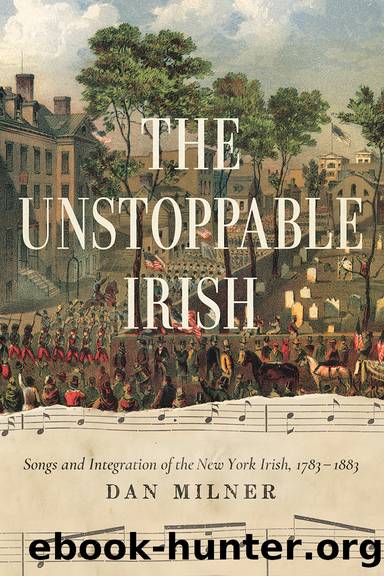
Author:Dan Milner [Milner, Dan]
Language: eng
Format: epub
Publisher: University of Notre Dame Press
Published: 2019-04-22T00:00:00+00:00
The New York Draft Riots of 1863
On 29 August 1862, Brigadier General Michael Corcoran addressed “an immense multitude” gathered on the Common in Boston, Massachusetts. The following day, an account in the New York Times (30 August 1862) reported, “Nearly all the stores in the city were closed, and the reception was one of the greatest ovations ever witnessed in Boston.” Freed from imprisonment only fifteen days earlier, Corcoran was in the Bay State recruiting for the Irish Legion. In his closing comments, he informed the crowd, many of whom he hoped to enlist, that “[the] President of the United States intends to follow up this war for the restoration of the Union, nothing more, nor nothing less. We have nothing to do with the Slavery question. As a matter of course, it will settle itself as we march along. The Government is not going to make war for it. We are fighting for the Constitution and the Union and nothing else.”
Ten days earlier, Corcoran had dined with President Abraham Lincoln at the White House and also met with Secretary of War Edwin Stanton, so it may be assumed that the general’s guarantee to the Boston crowd was based on guidance that came from the highest levels of government and had been cleared for use in his recruiting oratory. However, the promise to prosecute the war solely for the preservation of the Union evaporated in a little more than three weeks. Once the Emancipation Proclamation was declared on 22 September 1862, New York’s Irish adopted a mood expressed in part by “Parody on When This Cruel War Is Over”:
Och, Biddy dear, do you remember
Whin last we did meet?
’Twas at Paddy Murphy’s party,
Down in Baxter street;
And there, all the boys did envy me;
And the girls envy’d you—
When they saw my great big bounty
In Green-Backs, all new?
Next day, I shouldered my ould musket,
Braver than Ould Mars;
And, with spirits bright and airy,
Marched off to the wars;
But now me drame of glory’s over;
I’m home-sick, I fear;
I’d give this world for a substitute,
To take my place here.
(NYSL Broadside Ballads SCO BD0987)
This song expresses the sentiment that enlistment seemed like a good idea at first because it provided a significant reward, but proved otherwise once harsh reality set in. Certainly, this was due in part to the very nature of war, filled far more with horror than glory, but also owing to the changing rationale propelling it. A bonus or bounty might have provided the economic basis for a better future in the postwar era; however, if a Union victory implied the reconstruction of New York in a Republican vision broadly detrimental to most Irish residents, then the reward certainly would not warrant the risk.
The Emancipation Proclamation reaffirmed the ideal of human equality expressed in the Declaration of Independence and initiated the policy of Reconstruction by “thoroughly revolutionizing American race relations,” including demolishing the “caste system and racial bigotry in the North” (Schecter 2009, 62). But New York, which had been antiblack at least since 1800
Download
This site does not store any files on its server. We only index and link to content provided by other sites. Please contact the content providers to delete copyright contents if any and email us, we'll remove relevant links or contents immediately.
| Anthropology | Archaeology |
| Philosophy | Politics & Government |
| Social Sciences | Sociology |
| Women's Studies |
Cecilia; Or, Memoirs of an Heiress — Volume 1 by Fanny Burney(32558)
The Great Music City by Andrea Baker(32019)
Cecilia; Or, Memoirs of an Heiress — Volume 2 by Fanny Burney(31956)
Cecilia; Or, Memoirs of an Heiress — Volume 3 by Fanny Burney(31942)
We're Going to Need More Wine by Gabrielle Union(19046)
All the Missing Girls by Megan Miranda(16027)
Pimp by Iceberg Slim(14507)
For the Love of Europe by Rick Steves(14121)
Bombshells: Glamour Girls of a Lifetime by Sullivan Steve(14075)
Talking to Strangers by Malcolm Gladwell(13370)
Norse Mythology by Gaiman Neil(13365)
Fifty Shades Freed by E L James(13241)
Mindhunter: Inside the FBI's Elite Serial Crime Unit by John E. Douglas & Mark Olshaker(9343)
Crazy Rich Asians by Kevin Kwan(9292)
The Lost Art of Listening by Michael P. Nichols(7506)
Enlightenment Now: The Case for Reason, Science, Humanism, and Progress by Steven Pinker(7313)
The Four Agreements by Don Miguel Ruiz(6765)
Bad Blood by John Carreyrou(6621)
Weapons of Math Destruction by Cathy O'Neil(6280)
